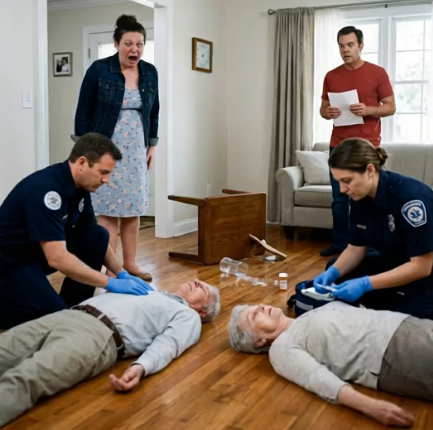
 The voice on the other end of the line was steady, soothing. I gave them my parents’ address, my words tumbling over each other like water pouring from a broken dam. They promised help was on the way. I sat on the floor between them, my knees pulled to my chest, the carpet rough against my skin. I watched the clock on the wall, its ticking suddenly audible, each second stretching like a rubber band pulled too tight.
The paramedics arrived in what felt like both an instant and an eternity. Their movements were swift, their words a flurry of medical jargon and instructions. I stood to the side, feeling like an intruder in my own childhood home, my mind numbing to the reality that my parents were being wheeled out on stretchers, lifeless yet breathing.
At the hospital, words like “poisoning” and “critical” floated through the sterile air, sticking to my skin like burrs. I sat in uncomfortable chairs under ghastly fluorescents that made everything seem surreal. My husband arrived, out of breath and wide-eyed, pulling me into a hug that was too tight, but I welcomed the pressure.
“They were poisoned,” a doctor confirmed, a sentence that should’ve belonged to a crime novel, not my life. The words tasted bitter in my mouth, like betrayal. Who would do this? Why? My parents were kind, ordinary people who wouldn’t hurt a fly, let alone make enemies.
A week passed in fits and starts, a blur of hospital visits and police interviews, sleepless nights and endless questions. My parents remained unconscious, machines doing the living for them. I sat by their bedsides, one hand on each of theirs, willing them to feel the warmth of my skin and come back to me.
Then, one evening, as I returned home to shower and grab fresh clothes, my husband met me at the door, his face ashen, a piece of paper trembling in his hand. “I found this,” he said, voice breaking like thin ice. He handed me the paper, its edges crinkled in his grip.
It was a letter, the handwriting unmistakably my father’s, shaky and uneven like the lines of a seismograph. As I read, my heart galloped in my chest, my body trembling in betrayal and fear.
“I hope you never find this,” it began, “but if you have, it means something went wrong.”
The letter unfolded a tale I couldn’t comprehend. My parents had discovered something—something they weren’t supposed to, something dangerous. It spoke of secrets and threats, of a decision to protect us by staying silent. The words painted a picture of a world I didn’t recognize, where shadows and whispers could wield deadly force.
The realization hit me like a physical blow: my parents were not just victims of a random act, but collateral in a story they never chose to be part of. My mind reeled at the thought of the dangers lurking in the corners of their quiet lives, unseen and unnamed.
As the weight of the discovery settled in my bones, I understood with chilling clarity that nothing would ever be the same again. My parents’ resilience had not only been their shield but now felt like a ticking clock, one that I needed to understand before it was too late.
I clutched the letter, my heart a drum in my chest. I vowed to uncover the truth, for my parents, for my family, and for a future that had suddenly become a lot more uncertain.