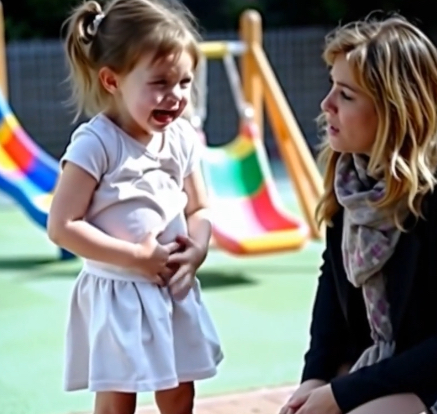
 The school day continued at Lincoln Elementary, but for Rachel Thompson, the world felt as though it had come to a standstill. Her thoughts were consumed by Emily, the little girl with the brave face masking a deeper pain. In her years as a teacher, Rachel had learned to trust her instincts, to listen not just to what her students said, but to what they didn’t say. And Emily had been saying a lot through her silence.
Returning to her classroom, Rachel tried to focus on her other students, masking her anxiety with the usual routine. The children could sense the tension, their eyes wide with curiosity and concern. “What happened to Emily?” one brave soul asked, breaking the thick silence that had settled over the room.
Rachel paused, choosing her words carefully. “Emily isn’t feeling well, and she’s going to get some help,” she said gently. “It’s important we all think good thoughts for her.”
As the day wore on, Rachel found herself glancing at the door, half-expecting Emily to walk back in, wearing her usual sunny smile. But she knew it wouldn’t be that simple. She thought of Emily’s family, wondering if they were aware of the situation, or if they were the very source of her pain. Rachel’s heart ached at the thought.
Her concerns were interrupted by a knock on the door. It was Principal Anderson, his face lined with concern. He gestured for Rachel to step outside. “I spoke with the authorities,” he said quietly. “They’re looking into Emily’s situation, and child services have been notified. They’ll want to talk to you about what you saw and heard.”
Rachel nodded. “Of course, anything to help Emily.”
“Rachel,” Principal Anderson added, his voice softening, “I know this is hard. You did a brave thing today, and you might have saved her from more harm.”
After school, as Rachel sat in her empty classroom, Emily’s absence was palpable. The room felt larger, and the usual chatter that echoed in the halls seemed muted. She looked at the small desk where Emily had sat that morning, the chair now tucked neatly beneath it. On the desk was a drawing Emily had made just last week—a vibrant picture of a big yellow sun shining down on a house with flowers in front. Rachel traced the outline of the sun with her finger, feeling the warmth of Emily’s spirit in every stroke of crayon.
Later that evening, Rachel sat at her kitchen table, staring at her phone. She had a choice: to push aside the day’s events and try to return to normalcy, or to ensure that Emily’s voice, once silent, was now heard. She chose the latter. Picking up the phone, she called a local child advocacy group, determined to follow through and ensure Emily received the help she needed.
As Rachel prepared for bed, she thought again of Emily, hoping she was safe and cared for, hoping that this was the beginning of healing. And she vowed to keep fighting for Emily and others like her, children whose voices were too often drowned out by fear.
In the darkness, Rachel whispered a silent promise to Emily and to herself: No child should walk alone through pain. Not while she had the power to help.